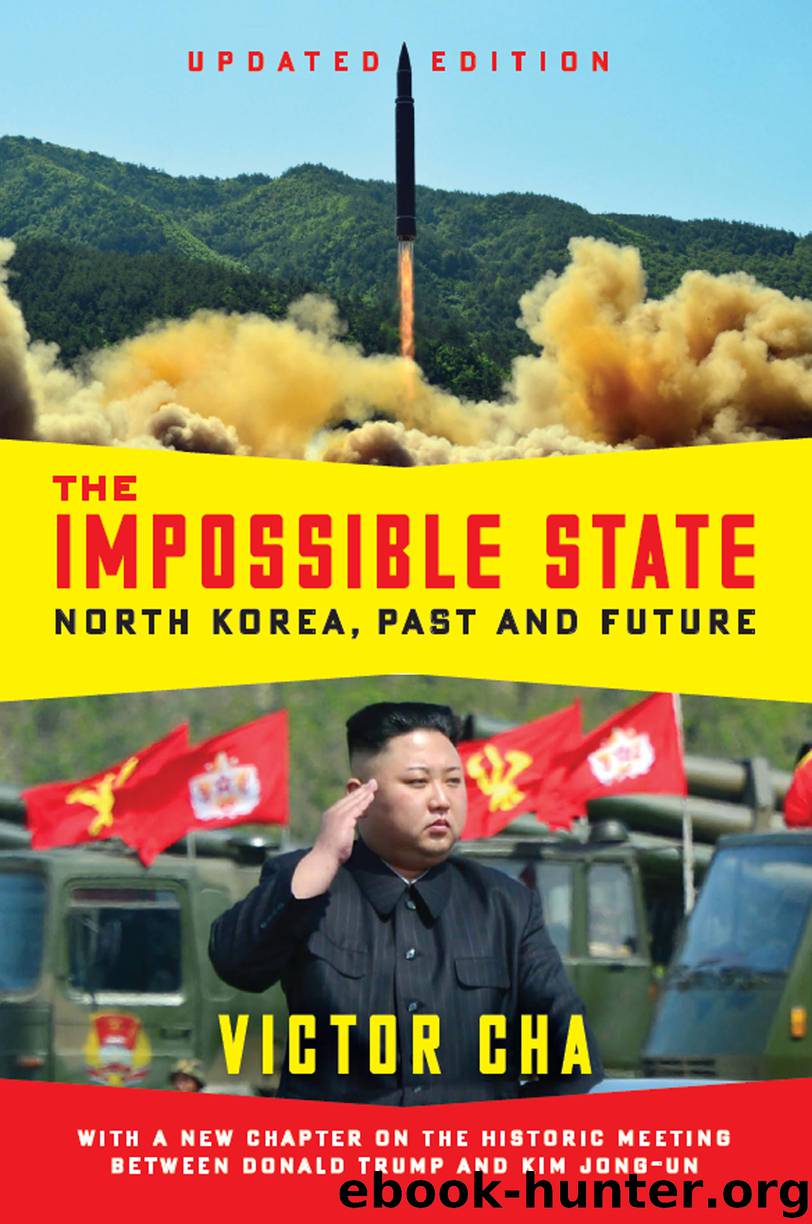
The Impossible State, Updated Edition by Victor Cha
Author:Victor Cha
Language: eng
Format: epub
Publisher: HarperCollins
Published: 2018-09-17T16:00:00+00:00
CLINTON: “NON-HOSTILE INTENT”
“A million, a hundred billion, and a trillion.”
When then–American commander of U.S. Forces Korea, General Gary Luck, was asked to clarify what he meant, the general explained that a second Korean War would result in 1 million casualties, would cost the U.S. $100 billion, and would cause $1 trillion in industrial damage. President Clinton recoiled at this estimate. It was June 15, 1994, and he sat in the Oval Office about to make a decision that could take the United States to war in Korea. Defense Secretary Bill Perry and Joint Chiefs of Staff chairman John Shalikashvili gave the president three options to respond to North Korea’s defiant actions. Despite being warned expressly by the United States not to unload nuclear fuel rods from the reactor at Yongbyon—the first step to making plutonium for nuclear weapons—North Korea crossed this red line on May 8, 1994. They blocked international inspectors’ access to their nuclear facility and then, on June 13, defiantly announced Pyongyang’s withdrawal from the IAEA.
While the Clinton administration was not ready to go to war over lies told by North Koreans to IAEA inspectors regarding the history of their nuclear program, it made clear to Pyongyang that Washington would consider all options to prevent the future growth of a nuclear weapons arsenal. Perry instructed the military to draw up contingency plans for a surgical strike on the nuclear reactor at Yongbyon to prevent the North from recovering the raw material from the eight thousand, yard-long, two-inch wide (90 x 5-cm) fuel rods to make nuclear bombs. Cruise missiles deployed by F-117 stealth fighters would do the job. Perry explained that the discreet mission could be accomplished successfully with little risk of radiation fallout. But, he added soberly, he also believed the preemptive attack could result in an all-out war.
Another option was to seek a tough sanctions resolution in the U.N. Security Council. But this diplomatic course also risked war. Robert Gallucci, the U.S. chief negotiator, recounted to the Oval Office attendees that he had been told personally by his North Korean counterpart in their last encounter that a U.S. move to sanctions through the United Nations would be taken by Pyongyang as an act of war. North Korea reiterated in a June 5 statement, “Sanctions mean war, and there is no mercy in war.”
Clinton deliberated over a third option, which was a significant force-augmentation package for Korea. This would entail the addition of ten thousand combat-ready troops, F-117 stealth fighters, long-range bombers, and an additional aircraft-carrier battle group. North Korea would almost certainly read such a buildup of U.S. forces as a precursor to war, and would react with either a mobilization of their own, or worse, with a preemptive attack before the United States could amass their forces (an important lesson Pyongyang learned from observing the 1991 Persian Gulf War). Secretary Perry assessed all options as bad. But to do nothing as the most opaque and unpredictable regime was driving to acquire nuclear weapons was disastrous. Clinton started leaning in the direction of the force-augmentation package.
Download
This site does not store any files on its server. We only index and link to content provided by other sites. Please contact the content providers to delete copyright contents if any and email us, we'll remove relevant links or contents immediately.
| Africa | Americas |
| Arctic & Antarctica | Asia |
| Australia & Oceania | Europe |
| Middle East | Russia |
| United States | World |
| Ancient Civilizations | Military |
| Historical Study & Educational Resources |
The Radium Girls by Kate Moore(12090)
100 Deadly Skills by Clint Emerson(4970)
Rise and Kill First by Ronen Bergman(4833)
The Templars by Dan Jones(4732)
The Doomsday Machine by Daniel Ellsberg(4538)
The Rape of Nanking by Iris Chang(4255)
Killing England by Bill O'Reilly(4041)
Stalin by Stephen Kotkin(4003)
Hitler in Los Angeles by Steven J. Ross(3975)
12 Strong by Doug Stanton(3575)
Hitler's Monsters by Eric Kurlander(3384)
The Code Book by Simon Singh(3250)
Blood and Sand by Alex Von Tunzelmann(3238)
Darkest Hour by Anthony McCarten(3161)
The Art of War Visualized by Jessica Hagy(3042)
Hitler's Flying Saucers: A Guide to German Flying Discs of the Second World War by Stevens Henry(2777)
Babylon's Ark by Lawrence Anthony(2717)
Tobruk by Peter Fitzsimons(2559)
The Second World Wars by Victor Davis Hanson(2553)
